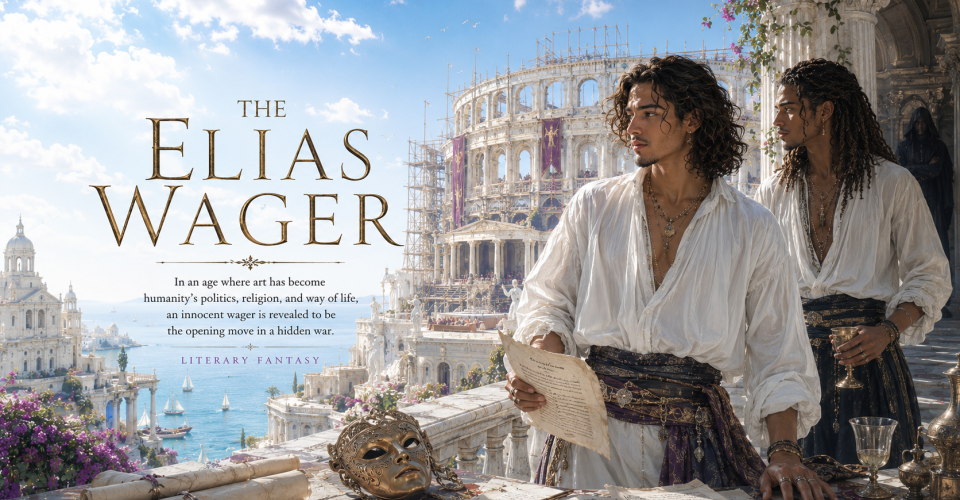
THE ELIAS WAGER
CHAPTER ONE
The Dossier
Malo stood up, several eyes following him as he bent to whisper in my ear.
"Come, I want you to see something."
His tone was low, but it was the look on his face that alarmed me.
I smiled at several members of our opposing troupe as they reclined on soft sofas and rich chaises. They returned the smile, but their eyes tracked us the entire way out of the room.
"What—"
Malo put a finger to his lips and led me into the study. Then he handed me a leather dossier.
Bound between its covers were several papers.
The name on the front page:
Nera.
I looked up, horrified.
"It was here." He shrugged.
"Out in the open?"
"As though someone wanted us to stumble upon it."
I guiltily read the first page. The title caught my eye.
The Soul Mate.
Odd.
I'd written a Revival years earlier called The Twin Souls.
I read on.
The resemblance was slight at first—a turn of phrase, a familiar rhythm. Then the similarities multiplied. The conflict. The longing. Even the emotional progression unfolded exactly as I would have written it.
I turned the pages faster.
By the end, I knew every scene before I reached it.
I stopped reading.
My play had been about a working-class man hopelessly devoted to a woman far beyond his reach. Nera's followed a young man pursuing his own soul as though it were a beloved. The stories were different. The themes were not.
They were the same play wearing different clothes.
I steadied myself before moving to her second piece. My hand raked through my hair. I didn't trust myself to look at Malo.
Then I lifted the pages.
The words of this great artist forced my eyes to eavesdrop on their silence.
Again, her pages reflected mine.
But before I finished, I closed the dossier.
It was as though I had discovered that up was perhaps really down, or that music had always been the spectrum of color and never sound.
I paced madly from one end of the room to the other. First, my mind wrestled with how this could be. Then it turned to how I might re-enter the drawing room without looking as though I had seen a ghost.
Malo placed his hands on my arms and sat me down.
For a long while, he looked at me with the same expression I'm sure I wore.
"How is it that this could be?" he asked in earnest.
"I... I don't understand."
"They don't frequent our Revivals."
"And neither do we theirs."
He shook his head, dumbfounded.
"Yes, I know," I lamented.
"Then how?"
If the foundation of our movement was diversity... then what I had just read should have been impossible.
Historians claimed civilization had come full circle. After a millennium of division and bloodshed, humanity abandoned the old identities that had fractured it. Religion faded. Politics became little more than administration. Art became the language through which we understood ourselves. We were not merely artists. We were entrusted with healing the human spirit.
Wealthy patrons supported us. Children of extraordinary promise were apprenticed to masters while still young. We were celebrated almost as mystics, believed capable of lifting souls beyond grief, prejudice, and despair.
Our greatest works were performed during three-day festivals called Revivals, where theatre, music, poetry, painting, and dance became a single work of art. A Revival was considered successful only if its beauty overwhelmed the audience into what became known as the Rapture.
Every troupe pursued beauty through its own philosophy. Diversity was not encouraged—it was sacred.
The Statesmen worshipped logic.
The Mutineers embraced contradiction.
The Purists sought the soul through detachment.
And we Romanticists lived for the passions of both mind and flesh.
No two philosophies could arrive at beauty in the same way.
Which was why Elias's wager—compelling the four great troupes to collaborate—was impossible.
CHAPTER 2
The Seed of Doubt
One of Astera's wealthiest patrons of the arts was Elias Costi. His old Spanish castle overlooked green everglades that gave way to the palm-lined Pacific.
Adjoining the castle stood a grand open-air theater beneath the stars. For weeks at a time, he'd invite one troupe or another, and hundreds of guests would gather to watch us perform.
We had just completed the last night of our three-day Revival, bowing to a roaring audience as dusk settled over the estate.
We bid the audience goodnight and entered the long hall leading back into the castle, passing cooks and the aroma of spices on our way to Elias's drawing room. Voices rang through the corridors, laughter echoing from every corner. Plays were made or broken on Elias's stage, and tonight the audience was still on its feet when we left it.
I searched for the most comfortable seat as Elias eyed me. When I glanced his way, his dark stare glinted with humor. I loved Elias's humor—except when it was directed at me.
"I must tell you, my good friend, that I truly believe there is little difference between you and the Purists."
Elias had a broad girth, and his voice carried the weight of him. He sat in his usual chair, the largest in the room. His loose silk sleeve slipped down his arm as he stroked his dark beard.
The Purists were like priests—not even priests I could understand. They spoke almost exclusively of death. They couldn't wait for it. We, on the other hand, were lovers of life. Carefree. Filled with fire. And if we could, we'd have lived forever.
I sat down, then stood again.
My colleagues laughed.
I ignored them and crossed to the bar to pour myself a glass of wine, much to the dismay of the servant who had just bent to offer me another bottle.
"We? The same as the Purists?" I said, drinking the glass empty and pouring a second. "There could be no similarity between us and those walking corpses." I lifted the glass into the air. "They would say this wine from your vineyard and red vinegar were the same."
"But you use the word Zen—a word they coined," Elias grinned, egging me on.
"Yes... a clever word. Stumbled upon by accident, no doubt. And I only used it as an insult. Not a compliment."
The troupe chuckled softly.
"There is something very wrong with artists—or anyone, for that matter—who view riches and poverty, pain and ecstasy, as the same experience." I took a deep drink from my wine, my eyes holding Elias's as my stomach clenched into a knot.
He smiled and swirled his drink in silence.
"Yes, yes, but your disagreeing does nothing to discourage my thoughts on the matter," he said at last, his voice dry and matter-of-fact.
The servant at the bar topped off his glass and circled the room tending to the others.
I walked around the room, admiring a painting I'd seen hundreds of times as though he'd only recently hung it. Then I moved on to the colorful animal-hide lampshades. Anything to distract me as I pondered a response.
All I could think of was:
"I think my excellent host has had too much to drink. For I am sure we are as different from the Purists as the sun is from the moon."
I turned away from the shade.
"As the tropics from a desert. Tell me, though—what has caused your madness? Surely your lovely wife must have a remedy."
I smiled, the quivers inside my stomach growing by the second.
Malo, the lead musician of our troupe and my best friend—no, my older brother, had I had one—strummed his guitar, the dark chords suggesting horror.
"I was speaking with Nera not long ago," Elias continued, crossing one leg over the other upon the ottoman while a large hand caressed the smooth velvet nap of the sofa. "She, Isaiah, and the others will be coming to perform for us in three weeks. I think you should stay till then."
I squinted. "You know they have no sex."
My comment tickled Elias.
"I don't suppose I want your company so that you might bed her."
Everyone laughed. My face warmed with blood.
"Besides, knowing her as I do, this would be as impossible as you swallowing the sun you just spoke of," he said, chuckling away what was left of my manhood.
"It's just that after talking with her about her newest prose, it reminded me very much of some of your latest works."
That was how it all started.
We talked a bit more on the matter, and I forced myself to remain for two more rounds of conversation before pretending I had to settle up with the barkeep on Artists Row or he'd make good on his threat to break my writing hand.
***
The wall sconces of Catacomb Hall flickered as I strode through them, Elias's words refusing to leave me.
I drank.
Then I drank more.
Hours later the music still played, but so did his words.
It reminded me very much of some of your latest works.
I rose, arms outstretched, the music seducing me. "Yes!" I shouted, lost in the moment. Then I collapsed back into my chair. His words still plagued me.
The reason why haunted me even more.
CHAPTER 3
The Purists
The sun blinded me as I stepped onto the empty sidewalk. A humid breeze rolled in from the sea, leaving the taste of salt on my lips.
I hopped onto my moped and slowed down before I reached the corner. It was at this intersection that I first laid eyes on the writer from the Purists.
Rarely did any from that troupe walk alone or even visit this part of Astera. But when I saw her, I suspected she was a Purist. She was just a girl then. No more than seventeen or eighteen, yet already on her way to becoming a legend. Every performance of the first play she wrote sold out after the opening night of the Revival.
I was young then too—older than her, but naïve and too emotional. I was curious. Curious about the young writer everyone was already speaking of.
I noticed her as she walked toward me in a long flowing pale dress. The wind in her long braids, the jewelry cuffs around her delicate wrists catching the sun.
My blood warmed as I watched her gaze across the beach. But I looked away when we passed each other. A few moments later, I glanced back. She was just about to disappear around the corner.
And to my surprise, she turned to look back at me.
"No..." I whispered, stunned.
I thought of her for two weeks. Haunted by that turn of her head and what it might’ve meant. But I wouldn’t see her again for over a year. And this time, she was surrounded by her troupe. They might as well have been monks. She sat between the tall director and a broad-shouldered premier player.
A harsh breath left me. Amusement, and something that cast a heavy, dark shadow inside me. They were dining, as was I, at DiNardo's.
Our eyes met three times. Three times she showed neither emotion nor recognition.
Desperation, or something close to it, made me slip through the crowd of patrons to see their most recent Revival. Their music was much different from ours. Sweet and sublime, chant-like in its timing. I was moved by her prose and impressed by the talent of the actors. Yet I left the theater angry. Empty. Confused.
I suppose they would say that this was their purpose.
"Emptiness is more real than substance," said one of the characters.
And then this line. This line I'll never forget:
"Since substance is nothing but illusion, your choices are but one, because they are in fact the same…"
Absolutely maddening.
CHAPTER 4
The Red Moon
"The Coliseum…!" Malo blurted out, then stopped.
"Yes…" I said, intrigued by the brightness inside his eyes.
"You realize Elias is building it?"
Of course I knew. It was the talk of the island. The colossal theater made of white stone that glowed at night. It would house three grand theaters, restaurants, hotel rooms, art studios, and penthouse suites.
Every artist would give almost anything to call one of those penthouse suites home. But no troupe could afford such luxury. We would have to settle for staying there only during the run of a Revival.
Then.
"The winners will be given permanent ownership of the penthouses. Two floors of living like kings, with enough rooms and studios to practice in!"
My feet stumbled backward. I couldn’t have heard Malo correctly. He was often difficult to understand. A man of few words, he usually let his guitar speak for him.
"What are you talking about? Is this some sort of riddle? Start again, will you?"
"The Coliseum will house three troupes."
"What?" I still doubted my ears.
"One set of suites will be for the performers, but the other two must be competed for."
"What are you saying?"
"We must find common ground with the Purists, write and perform together—and the Statesmen must do the same with the Mutineers. The winners will receive the suites as life estates."
I let out a bitter chuckle. "As life estates?" I mused. The Mutineers and the Statesmen would never find common ground. "The Statesmen and the Mutineers?" I spat.
The expression on Malo’s face gave me pause, but I continued, still not quite catching on.
"The Statesmen can't finish a sentence under twelve syllables, and the Mutineers?" I gestured with a flippant wave of my hand. "They contradict themselves between breakfast and lunch."
My eyes narrowed as the smile faded.
"Yes…" he said, seeing the workings of my mind.
"My word."
"How will you do this?" His expression brought back memories of when he was just a boy, on fire with some new musical composition.
"It is inconceivable." My brows drew tight. "It is entirely impossible for us—we who love life, who love love and fire—to merge with them."
Even the thought made my gut churn as though I’d swallowed a handful of rocks.
"But you must," he begged. "To live in the Coliseum, to act there at our leisure, to dine and entertain within those absolutely luxurious walls—Dario, you have to find a way."
His eyes took on a far-off look. I hated to disappoint him. But it was true. Our philosophies were mutually exclusive. My heart sank. Why did fate appoint me to be the one to thwart the dreams of my colleagues?
"What about Nera and Isaiah?" I said, thinking I could blame it on them.
"He hasn't told them about the wager yet. They are due in three weeks to perform here. But in the meantime, Dario, you must think heavily on this."
Hearing that they didn’t know yet was a relief. They would protest and refuse to go along. All I needed to do was bide my time and let the Purists do what they always did—make some comment about how all things were possible in spirit, but not in flesh.
We were still staying at Elias’s, but after the proposal I couldn’t bear to look into the faces of my colleagues. We’d left our families young to train with the masters. Now we were all we had. The weight on my shoulders felt as though the gods had placed a mountain upon them.
I stayed in my room and composed scenes as though Nera were at my side. Crumpled pages overflowed the wastebasket and spilled onto the floor.
I walked the grounds, hoping to clear my head and start again. I avoided the drawing room and dining room, where everyone gathered to enjoy Elias’s entertaining conversations.
I tiptoed toward the stairs and nearly tripped. Snatches of conversation seeped into the hall as I straightened the edge of the runner that had folded backward.
Elias laughed heartily. "If I had known this would pain him so much, I would have paired you all with the Mutineers!"
"No!" Jovani, our premier dancer, cried. "That would be worse."
"The Mutineers contradict their own beliefs," Malo said with a strum of his guitar.
"You have a point," Elias agreed. "But surely this can be done. The Statesmen say all things are possible."
"But the Purists say perfection exists only in the after-world."
I’d heard enough and continued up the stairs.
"You need inspiration," Malo whispered through the closed door, the way he did when we were youths daring to sneak out of the compound to convince a barkeep to bring us a mug of beer.
I opened it, desperate for company.
"Malo," I said with a breath of despair.
"Come. Let us walk the streets and see what finds us."
* * *
We rode into town, the streets alive with couples strolling hand in hand and lone musicians playing along the beach, hats and open guitar cases waiting for spare coins.
The full red moon promised a night of surprises as we sauntered down Beach Row, the neon lights of theatres, hotels, and restaurants spilling across the sidewalks overlooking the ocean.
Malo hooked my arm, jerking me backward so we could claim the only two empty stools at an outdoor bar.
The doors to the bustling, dimly lit restaurant were open. Laughter and the buzz of conversation drowned out the music.
Malo ordered dark beers for us both while my eyes roamed the crowd in search of inspiration.
I caught the beer the bartender slid my way with a sigh and a long drink.
Malo's gaze tangled with a pair of intriguing gray eyes. I grinned as he drifted away, leaving both my side and the empty stool beside me as though neither existed.
In the time that passed, several women sat next to me, then later several more. I'd lost count of how many beers I'd had when a woman, alone, came and took up the once-again-vacant seat.
Unlike the others, she sat beside me with a sense of composure and stillness that slowly unsettled me.
I turned to her, intrigued by her self-sufficiency.
"Are you drinking?" I asked.
She looked up from the menu and glanced toward the busy barmaid.
"May I?"
"Red wine," she said. "Cabernet, please."
I caught the barmaid's eye and ordered for her.
"You're a writer," the woman said.
"Yes, and I am looking for inspiration."
She looked around and asked, "Do you suppose you’ll find it here in a bar?"
Her skin was smooth, her lips full, and her eyes, now that I noticed, were sublime. Suddenly the warm evening smoldered.
"Here is as good as any other place. The world is as large, or as small, as where I stand."
"Yes, I suppose you're right."
"Tell me — may I be bold with you?"
Her eyes brightened, but she acquiesced. "If it helps you with your inspiration, I am obliged. We patrons live for art, do we not?"
That wasn't the answer I'd expected. I traced the rim of my beer mug with one finger. "What brings you out alone?"
"I'm staying at the World Hotel. I was bored and thought a walk would be refreshing. I turned my head, saw this place and the empty seat…"
"And right now, are you pleased to be here, or wishing you had stayed in your rooms?"
"I am pleased."
"And how is this pleasure noted by you? Is it in feeling, or merely a thought? Are you pleased simply because you thought it pleasing before you left your suite, and so this is all the evidence you need?"
"I know it as a thought, I suppose."
"Hmm… then how do you know you are pleased? Think now that you aren't, and tell me if it is true that you are not." I frowned. "Or — are you still pleased?"
Her brow crinkled as she considered my experiment. "No, I'm still pleased."
I shook my head. "I don't understand. I don't see how a thought separated from a feeling can testify to anything other than mere words. Don't you need a feeling to know something is real?"
“Are you a Mutineer?”
“God, no.”
She grinned.
“I am a Romanticist."
"My thinking is more aligned with the Purists. In fact, I am in town to see their Revival. You might frequent their work. Next week they will be playing at a wealthy patron’s estate." She paused in thought. "I forget his name at the moment, but if you ride in the direction of the everglades, you'll see a castle. Surely you know the place?"
My lips twitched, one lifting higher than the other. “…I see."
"If you do," she began, her voice soft and even, "then you realize that I don't believe your feelings attest to anything any more than you believe my thoughts do. Thoughts are realities; feelings come and go. They last mere moments. And thoughts needn't a feeling to confirm what the mind dictates as so."
She quoted the Purist. It was a popular idiom.
I finished my beer with a thirsty gulp and a sigh. "You are right, señorita, and having told me where your thoughts are aligned, I see there isn't a way that we could talk further." I was about to leave, then added, "Though I must admit, your eyes will haunt me for days. No, for weeks…" I smiled as best I could, and found Malo in the midst of a cheerful crowd.
"Have you found yours?"
"No," he answered, grinning and shaking his head pitifully. "I am enjoying myself, however. But we are on a mission." His brows creased. "Let us get on." He nodded to his group.
We left convinced we’d find our inspiration yet. But the red moon had broken its promise.
CHAPTER 5
The Play
The woman's words played in my head.
"Thoughts are realities; feelings come and go."
I had argued against her, but it was her certainty that wouldn't give me peace. The way she’d spoken without the slightest need to persuade me. This, I realized, was what unsettled me most about the Purists. The self-sufficiency of their character. The way they required no one to agree they were right.
After coming face-to-face with a Purist follower, I was confident I’d do a better job of composing a few scenes that would convince my troupe that my inability to write with Nera was by no means my fault.
By the time the first gray light crept through my window, I realized how long I’d been writing.
My desk had disappeared beneath scattered pages. Crumpled pages littered the floor. I paced. Wrote another line. Scratched it out. Wrote it again.
A quiet knock sounded at the door.
"Dario?"
I looked down at my clothes. The same ones I’d worn yesterday. I didn't answer.
The door opened anyway.
Malo stood there, guitar slung over his shoulder, looking from the papers on the floor to the untouched bed.
"You haven’t slept."
"I've been working."
"I can see that."
He stooped to pick up a discarded page, read half a sentence, then crumpled the page inside his palm.
"You've written her," Malo observed, holding back a grin.
"I've written an argument."
He smiled. "Is that what we're calling her now?"
"I don't even know her name." I crossed my arms over my chest, thinking of the woman's eyes.
His brows jumped. "Oh, so you’re not writing about Nera?"
I held up the pages. "Sit."
Malo sighed with theatrical resignation and lowered himself into the chair opposite my desk.
"You are going to make me listen, aren't you?"
"I am."
He leaned back. "Very well. Convince me. But at least tell me who the protagonist is."
I ignored his request and cleared my throat.
ACT I
A Romanticist reclines beneath an oak while a Purist sits upright against its trunk.
ROMANTICIST
Surely Heaven envies us our senses.
PURIST
Heaven does not envy what vanishes.
ROMANTICIST
Yet love vanishes all the time.
PURIST
What you call love is merely appetite dressed in poetry.
ROMANTICIST
Yet truth and poetry have been known to exist since the beginning of time.
PURIST
Not so. Truth survives the poet.
"And this is how you expect to find common ground?" Malo replied after I read the first page.
"Go on," I urged him. "You haven't yet read page two."
"If page two is anything like page one, I’ve read enough." He shook his head wearily.
"This is my inspiration!" I insisted, waving the pages in the air. "This is what I learned from my muse last night."
Malo's eyes drifted toward the heavens, his lips moving.
Por favor, Dios.
I read his lips.
"Then we may as well pay the roofer three months' worth of performances and paint the apartment, because we certainly won't be moving."
"I don't understand you." I frowned. "Do you really think some other dialogue is going to emerge from my collaboration with Nera?"
"So we are speaking of Nera?"
My mouth parted. My eyes drifted to the pages littering the floor. They had seemed like truths until I'd spoken them aloud.
"Dario, we've lost the wager before it's even begun."
I hurled the two pages I'd written to the floor. They drifted gently through the air, as though mocking the words written on them. I growled at their defiance.
Elias, who had been standing in the doorway, stepped into the airy bedroom. He came to stand beside Malo, blocking the sunlight so its rays stretched around him. It was odd seeing Elias appear almost ethereal. But in that moment, he came as close as he ever would.
"You are struggling?" he asked with a wicked smirk.
I grumbled. "About as much as you would expect."
He nodded, his eyes settling on the pages strewn across the Turkish rug.
"Then I have a solution. Will you hear me out?"
"Of course. How could I not? You treat me like a son, feed me like a king, and offer me a bed more comfortable than any I'll ever own." My lips spread into a genuine smile, despite the torment clawing through my stomach.
"I'll hear you out... and more."
"And more?" His dark brows rose across his smooth brown forehead. "That is fortunate, because Nera will be coming this evening—alone."
I coughed, having just swallowed... or attempting to. My eyes snapped to him.
"Isaiah asked her to give my wager her consideration. And he did so knowing you were all here."
The cough finally barked its way out of me.
Malo chuckled quietly.
"Yes." Elias beamed like an apprentice proudly displaying something he'd carved from a discarded piece of wood. "I found that interesting as well. I suppose it means her approach will be more magnanimous than yours."
My breathing finally settled.
"And what makes you think that?" I asked, my face suddenly warming.
I had no idea why.
"Oh, I heard your fascinating dialogue with the imaginary Nera." His smile widened. "But knowing her as I do—and knowing that you don't know her at all—I can tell you this."
"And what is that?" My back straightened, my chest lifting.
"Your conversations won't even exist in the same universe as the one you've written."
Had it been anyone other than Elias, I might have taken offense. But because it was Elias, I found myself not insulted, but curious about what was to come.
I passed on the plate of hors d’oeuvres, my stomach too tight to eat as I listened to the gossip surrounding the Statesmen and the Mutineers merging. Apparently, the owner of DiNardo's, having heard of Elias's wager, had held a dinner for the two troupes. According to Jovani, it ended early after one of the directors hammered his fist against the table and a bottle of wine rolled off its edge and shattered.
Jokes were plentiful, and the mood inside Elias’s drawing room was boisterous, apart from me and Elias’s wife. But she rarely spoke.
The room hushed when the door chimes rang out.
My heart plummeted so quickly I excused myself for the bathroom. I'd passed on the hors d'oeuvres, but that didn't mean breakfast wasn't waiting to make its entrance.
It didn't take long for her to be ushered through the halls. I heard the servant speaking to her as I stood in the lavatory, never fully getting sick.
I stepped to the door, my breath on pause and my ear against the cool surface as I listened for the voice I’d never heard before.
She said very little—"Thank you, water will be fine."
Soft, confident. Warm. Even friendly. All of that in five mere words. But most of all, it was nothing like the voice of the Purist I’d written.
I turned to the mirror. My brown skin shone like gold beneath the sudden perspiration. I let the water run until it felt icy, then splashed it on my skin. Shocking. Almost too cold. Then refreshing.
I could do this.
I slipped into the hall after the servant left. One of the players asked Nera if she wanted to taste Elias’s wine.
"It’s from last year’s harvest," Elias said.
I huffed softly, knowing she would refuse.
"That would be lovely."
I jerked upright, my arm nearly toppling the vase on the hall table. I stilled it quickly, just in time to hear her ask:
"What are you playing?"
She’d posed her question to Malo, who was strumming on his guitar as usual.
There was a pause. I knew what Malo looked like when he was speechless. The Purists' music was chant-like, delicate, and orderly. Malo's was raw, his diminished chords plucking at the heart until it ached.
His eyes would have been closed when she walked into the room. His head bowed toward his true lover—the instrument on his lap.
His words were brief.
"Thank you… A composition inspired by my anticipation of your presence."
I stepped into the drawing room.
Every head turned.
"And this is Dario!" Elias's voice carried his cheer inside it. "Your accomplice, if you so desire!"
I inclined my head serenely, but as I bowed, my heart raced to the moon and back.
"Dario." The air left her lips with my name. "It is so good to finally meet in person the brilliant artist that I've come to admire."
I was as speechless as Malo had been moments earlier.
When she stood to shake my hand, mine shivered before her skin touched it. My lips parted, the comment slipping away before I could speak.
"I would not have expected you to be shy." She smiled genuinely, and then came loud laughter from everyone.
In the background, I heard comments that described me as roguish and extreme—and I cringed at the rest. But still, I was speechless!
Elias took over mercifully and began to explain the wager.
The room quieted. The details were important, even if we’d heard them before.
I studied her carefully so I wouldn’t miss the mild disgust, or at least the shock she would politely hide.
Instead, she nodded, her eyes lit with interest as she turned to look at the players she seemed willing to collaborate with.
"And what is your reply to this merging of ideologies?"
I shrugged good-naturedly. "I say: Vive para aprender."
Malo's fingers plucked the wrong note. Someone set down a glass. The room felt like a theater curtain lowering.
"Very well, then. Shall we begin?"
I glanced around. The walls seemed to have drawn two feet closer.
"Oh—is this evening for socializing only?"
I gestured quickly, my brows lifting as I shook my head. Of course not.
"No, we should begin. Who knows, the Mutineers and the Statesmen may already have Acts I and II written down."
Nera smiled, and we left the room for the library, every eye following us. My back felt like a bullseye riddled with holes. As we crossed into the hallway, my hand drifted toward the small of her back, then stopped.
The library's large windows opened onto a terrace overlooking the south garden, where the stables sat in the distance. Often Elias's horses roamed freely or grazed on the thick grass. Tonight the land stretched toward the trees, the moon laying silver across the blades until they disappeared into a sea of black.
At first, the only thing that occupied my mind was the pockets of laughter quietly slipping down the hall and into the room. Then it was the fact that I was sitting across from the playwright the entire island revered.
She twirled her pencil between her fingers the way a drummer toys with a drumstick. Mine remained perfectly still.
I said nothing.
She stood and leaned against the side of the terrace window, her eyes on the green field that stretched until a wall of palm trees cut it off.
My fingers curled slowly before I forced them open again. A bead of perspiration tickled the stubble above my lip. When she turned, I lowered my face, pretending some great interest in organizing the pages so they were perfectly aligned.
She sighed softly, seemingly at home in the silence.
I looked up at her. My lips twitched once.
She was thinking. I was doing everything but thinking.
Then she spoke, her voice parting my mind like a summer wind.
"I have an idea for the basis of our Revival. You see, we must win."
I sat up straighter.
"Not because winning is necessary, but simply because it intrigues me more than losing."
Her face, so serious a moment before, broke into a smile. Her lips twisted naughtily.
Something inside me loosened.
"I would've thought winning and losing were the same to you." I winced after the words came out. I’d been wrong about her on almost every count so far.
"They are. But it does no harm to prefer one experience over another. Care, I do not. But prefer? Yes, I prefer many things over others. If what you mean to imply is do I care, then no, I do not. I do not fret or worry, nor run things over and over in my mind. But prefer?" Again, that naughty smile that disarmed me completely.
"Yes, I do prefer."
She didn’t seem to notice my reaction. She had an outline already laid down in that strange mind of hers.
She began picking words from thin air.
I could have passed out in ecstasy if I hadn't been so neurotically uptight.
She stood to pace, then paused and spun around. I imagined her turning on one toe like a dancer.
"We must prove that what is essential in life is both the tangible and the intangible…"
Her long braids, adorned with golden hair cuffs, reminded me of Egyptian queens. Her eyes radiated intelligence, but her lips—they curved in smiles that teased and hid much more than they revealed.
She sat down again, sighing softly and stretching her arms leisurely along the back of the chair. My eyes followed her long fingers as she drew her mane across the soft folds of her pale-yellow gown.
"I think… Yes. I think we should pair together: a man much like you, passionate and always willing to feel life, and a woman much like myself… She… She falls in love with him." Her eyes had been looking toward the curtain blowing softly before they snapped my way.
I heard myself interrupt her. "…But he doesn't believe her. She neither cares for his touch, nor is repulsed by it. She loves him, both from afar or in nearest approximation; it matters not to her." I thought this would tangle her logic.
It didn’t tangle. She didn’t even pause to regroup.
"But to him"—she was close to ten years younger than me, but her expression had the confidence of a woman much older—"he believes only in fire. Having no appreciation for the blue serenity of coolness, he thinks she's a liar. How could she love him? They’d crossed paths before, and when they did, she looked the other way. How could she love him and never lift a finger to hasten fate? For if it were he, he would have—"
"Taken fate… into his grip…" I started, the words puttering out like an old train. "And forced… Forced it to play its hand at the will of his passion." I felt my fingers draw into fists again before they sprang open, stretching long.
"And so," she began like a strike of lightning, "she sets out to illuminate the meaning of love for him… It is… It is…" She stood, her eyes still on the view outside the castle before she crossed the room.
"It is more than what he believes. And he sets out to illuminate her too. Love may be as expansive as she knows it to be… but…" Her eyes turned back to me.
"But it’s also blatant… Barefaced." The last word dipped. I stared at her, my heart racing.
Her eyes were tender just then. Her body lithe like a dancer. I tried to think of something to distract…
She played the piano.
Probably left home the day after she turned thirteen. No. The hour after.
Then my mind whispered that she was a Purist. As though I needed a reminder. Perhaps I did. But no—she speaks of love so freely and smiles as the words leave her lips. No. No. No, she can't feel pleasure. That smile meant something else. But what? Did I dare question it?
 Share
Share Print
Print 